Energy transition / Capital allocation / Innovation governance
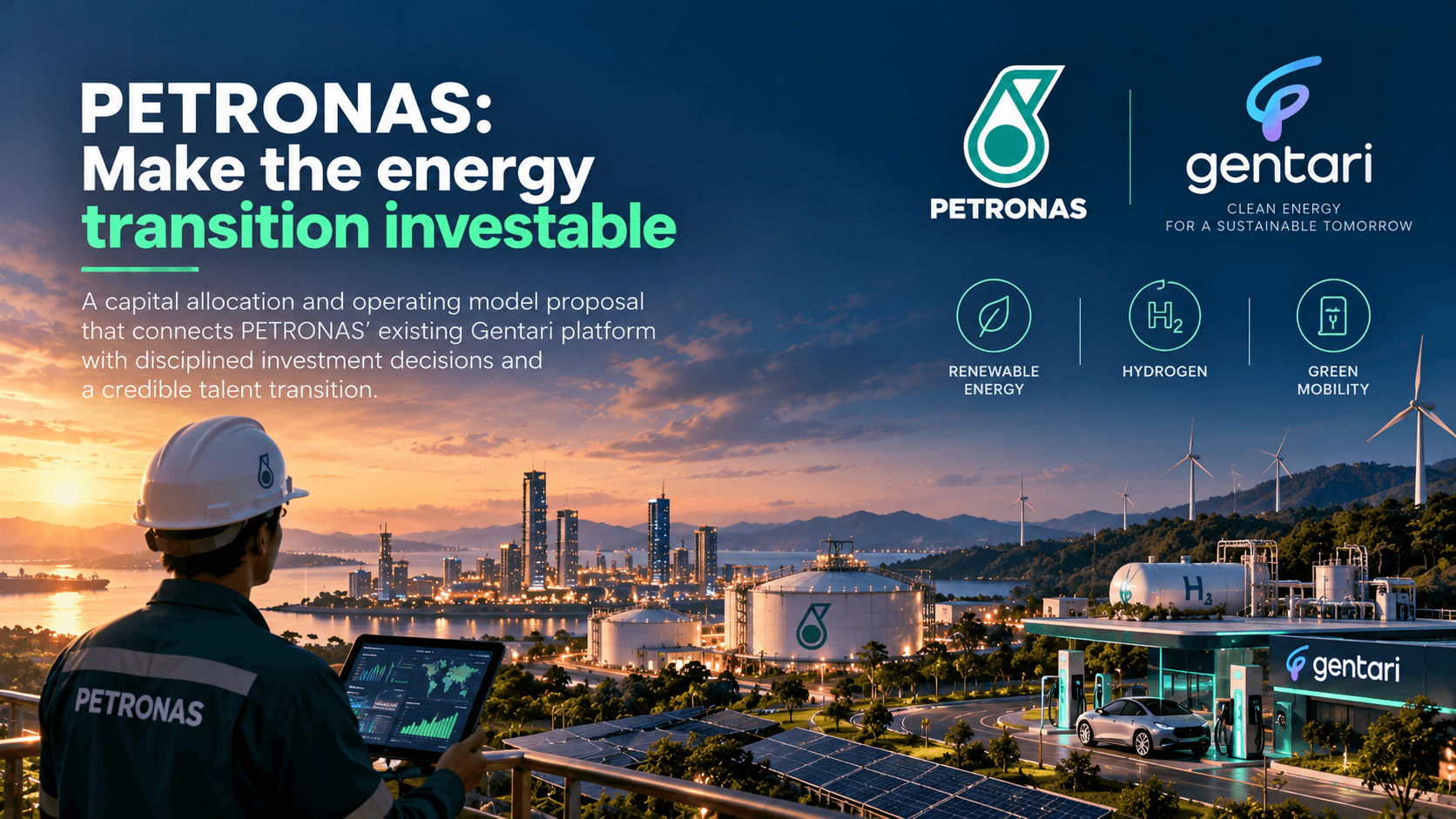
PETRONAS: Make the energy transition investable
A capital allocation and operating model proposal that connects PETRONAS’ existing Gentari platform with disciplined investment decisions and a credible talent transition.
The recommendation
The strategic question is how to scale an existing clean energy platform with capital discipline.
PETRONAS must develop lower carbon growth while sustaining the operating resilience and cash generation of its established businesses. Gentari, launched in 2022 as an independently managed, wholly owned clean energy entity, provides an existing platform for this transition. The recommendation is to strengthen the interface between parent and subsidiary: clarify investment authority, separate commercial maturity from technology promise, and make talent transfers practical. This proposed model allows renewable projects, emerging hydrogen opportunities and legacy operations to receive scrutiny suited to their economics.
Decision at stake
Strengthen PETRONAS–Gentari investment and talent governance, with staged funding and explicit commercial gates, before proposing another organisational layer.
An individual Managing Innovation & Creativity case examining PETRONAS’ energy transition through published 2022–2024 disclosures. The governance model is an external academic proposal.
Evidence and decision parameters
- Existing platform
- 2022
- Gentari’s official launch predates the assignment’s proposed new division; this is a factual correction, not a project achievement.
- Published 2024 context
- 8 GW
- PETRONAS reported Gentari renewable capacity installed and under construction combined. It is not all operational capacity or an outcome of this study.
- Proposed investment discipline
- 3 gates
- Screen strategic fit, validate commercial feasibility, and authorise scale only after delivery evidence.
Start with the capital allocation problem
Energy diversification creates a management tension rather than a simple technology gap. Established assets require safe operations, maintenance and selective investment. New businesses need patient development capital, unfamiliar commercial capabilities and tolerance for uncertainty. Applying one approval logic to both can starve promising opportunities or subsidise projects whose customer economics remain weak. The case therefore asks how PETRONAS can support a different business model without weakening group accountability.
Creative problem solving, SCAMPER and change management help translate this tension into operating choices. Public disclosures establish the clean energy platform. A defensible investment programme would additionally require internal cash-flow scenarios, capital commitments, approval-cycle data and role-level workforce information to identify constraints and determine the pace of transition.
An existing platform changes the recommendation
Gentari’s September 2022 launch announcement describes independent management and three businesses: renewable energy, hydrogen and green mobility. PETRONAS’ 2024 integrated report also identifies Gentari as its clean energy growth vehicle. Creating another division with the same mandate would therefore risk duplicated investment committees, competing talent requests and unclear ownership. The revised problem is the quality of coordination across an existing organisational boundary.
The proposed diagnosis tests three hypotheses: whether investment approvals match opportunity maturity; whether shared services support an appropriate development pace; and whether engineers and commercial specialists can move between businesses without ambiguous careers or conflicting incentives. Internal decision logs, service performance and employee feedback would be needed to determine which constraints are material. Public information alone cannot establish that these problems occur today.
Choose governance before adding structure
Three options deserve consideration. A new internal division offers direct parent control but duplicates Gentari’s mandate. An acquisition-led strategy can accelerate access to assets and capabilities but adds valuation, integration and country risks. Building through the existing platform preserves organisational continuity while allowing partnerships or acquisitions where they solve a specific gap. The third option is the recommended starting point because it can be tested without committing to structural duplication.
The decision process should compare development cost, contracted demand, delivery capability, financing, downside exposure and strategic fit. Qualitative attractiveness alone cannot determine investment merit. Renewable power and early hydrogen ventures should face different evidence requirements. A hydrogen memorandum of understanding is a development signal; it does not establish bankable customer demand or justify construction funding.
Give autonomy a clear commercial contract
The proposed operating model gives Gentari responsibility for customer propositions, project development and delivery within delegated limits. The parent retains portfolio exposure limits, financing standards and group risk oversight. A jointly agreed decision-rights charter would define when projects advance, who resolves conflicts, and which services can be shared. This avoids making autonomy dependent on informal sponsorship while preserving independent scrutiny of commitments.
Talent mobility should follow identified capability demand. A people team could map roles, agree secondment terms and assess practical competence before expanding retraining. Managers would be accountable for releasing staff and retaining critical operational coverage. Training volumes should follow project demand and skill gaps rather than an arbitrary headcount target. Completion certificates alone would not demonstrate readiness to deliver commercial renewable or hydrogen projects.
Measure conversion to value, with downside visible
A proposed investment dashboard would distinguish pipeline, approved commitments, construction and operating assets. Financial measures would include project cash-flow resilience, capital committed at risk, development expenditure per approved project and actual performance against approval assumptions. Operational measures would track commissioning delays, availability and customer contract coverage. The finance owner would reconcile these categories rather than presenting cumulative capacity as evidence of realised returns.
Environmental measurement would use a documented baseline, defined boundaries and transparent treatment of lifecycle emissions and renewable attributes. Avoided emissions should be reported separately from reductions in PETRONAS’ own operational footprint. Benefits remain prospective: the contribution is a decision architecture for testing investments and stopping weak proposals earlier.
Strategic priorities
Use the existing platform
Group strategy and Gentari leadership should agree a single mandate and escalation route, checking existing arrangements before introducing any new committee or organisational layer.
Fund evidence in stages
Investment owners should link each funding tranche to customer commitments, technical feasibility and financing readiness; retain stop, redesign and partner options at every review.
Make capability transfer measurable
People and business leaders should connect secondments to specific delivery roles, assess competence in practice, and protect safe staffing in the sending business.
Path to implementation
Proposed sequencing and decision gates.
Proposed · Months 1–2
Establish the decision baseline
Group strategy and finance map mandates, approval routes, committed capital and project maturity; people leaders map capability demand.
Decision gate: Agree accountable owners, a reconciled portfolio baseline and the specific coordination problem to solve.
Proposed · Months 3–6
Test governance on selected opportunities
Gentari development teams use the revised charter on a bounded project cohort; finance challenges commercial assumptions and records decision time.
Decision gate: Advance only projects with acceptable downside exposure, credible delivery plans and sufficiently evidenced customer demand.
Proposed · Months 7–12
Review performance before expansion
The portfolio sponsor compares approvals, delivery milestones and talent outcomes against the baseline, retaining independent challenge.
Decision gate: Expand governance changes only if decision quality and accountability improve without weakening operational controls.
Value and measurement
The academic work produces a strategic diagnosis and implementation proposal. Intended business value is better capital sequencing, clearer accountability and targeted capability development. No PETRONAS or Gentari investment, organisational change or financial benefit was delivered by this study.
Sources and scope
External evidence supports company context, not a diagnosis of internal performance. The revised model requires management validation, asset-level economics and country-specific feasibility work. Assignment targets for renewable revenue, retraining and R&D reallocation are not treated as company commitments or forecasts.
Original individual assignment
APU archive: Managing Innovation & Creativity_Assignment/Petronas_MCI_Assignment_v2.docx. The completed report supplies the creative problem solving and change-management foundations; its proposed new division is reassessed here.
- Gentari official launch · September 2022 (opens in a new tab)
Primary source establishing the existing independently managed clean energy entity and its three business pillars.
- PETRONAS Integrated Report 2024 (opens in a new tab)
Primary company context, including Gentari’s role and the reported 8 GW installed-and-under-construction capacity; these are historical company disclosures.
Continue reading
Related case studies
Statistical analysis / Investment prioritisation / Innovation ecosystems
Prioritise business capability in the innovation investment agenda
A cross-country statistical case that turns innovation indicators into a cautious investment agenda, with explicit separation of association and policy impact.
Product innovation / Consumer strategy / Change management
Nestlé: Reduce sugar without losing the customer
A reformulation strategy that treats nutrition, sensory acceptance, manufacturing cost and repeat purchase as joint conditions for scaling healthier products.

Innovation strategy / Platform competition / Organisational design
Nokia: Fund the next business before the core stops paying
A retrospective innovation strategy translating Nokia’s smartphone transition into practical choices about protected investment, ecosystem readiness and evidence-led experimentation.