Innovation strategy / Platform competition / Organisational design
Nokia: Fund the next business before the core stops paying
A retrospective innovation strategy translating Nokia’s smartphone transition into practical choices about protected investment, ecosystem readiness and evidence-led experimentation.

The recommendation
Protect exploration from the core business while keeping platform and commercial evidence visible.
The Nokia case examines an incumbent’s response as customer value shifted toward software, applications and integrated experiences. Two management levers emerge: an autonomous innovation unit and discovery-driven experimentation. Their effectiveness depends on the nature of the competitive threat, the costs of separation and the quality of learning gates. The resulting playbook is a retrospective proposal; it cannot establish that one structural change would have guaranteed a different outcome.
Decision at stake
For an incumbent facing a comparable platform shift, protect a bounded exploration portfolio and release further funding against customer behaviour, ecosystem participation and technical delivery evidence.
Developed from the completed New Product Development & Innovation group assignment on Managing Disruptive Technology Change. The analysis concerns Nokia’s historical smartphone transition, approximately 2007–2014.
Evidence and decision parameters
- Historical analysis window
- 2007–14
- The case examines the smartphone platform transition and subsequent sale of Nokia’s Devices & Services business; it does not assess present-day Nokia.
- Source recommendations
- 2 levers
- An autonomous innovation unit and experiments to identify viable markets form the assignment’s managerial contribution.
- Documented personal role
- Part C
- The supplied group report explicitly attributes managerial recommendations to Roshmeet; the whole report is retained as group work.
The basis of competition moved beyond the device
The smartphone transition moved competition from handset features and manufacturing execution toward software platforms, developer participation and connected experiences. Device improvements can become insufficient even while they generate revenue. Leaders must examine value across the wider ecosystem rather than infer future competitiveness from existing product performance.
Nokia’s 2011 annual filing documents its move to Windows Phone and acknowledges the transition from Symbian and MeeGo. Its 2013 reporting records the agreement to sell substantially all Devices & Services to Microsoft and the transaction’s completion in April 2014. These primary documents provide historical anchors. They do not support the simplistic claim that Nokia never invested in smartphones or lacked all relevant innovation capability.
Use the right innovation diagnosis
Calling every market-changing technology disruptive can obscure the response required. Christensen, Raynor and McDonald’s clarification describes the original iPhone as a sustaining innovation relative to existing smartphones. Nokia’s experience is therefore better examined through the combined lenses of platform competition, architecture and organisational adaptation. The distinction matters: a premium ecosystem challenge may require different commercial responses from a low-end entrant serving overlooked customers.
Vuori and Huy’s historical research into shared emotions and attention at Nokia identifies how pressures across managerial levels affected communication and innovation priorities. It supports examining the quality of escalation and decision information; it does not establish that every delayed product decision arose from fear. This analysis uses the published study and claims no original Nokia interviews.
Separate exploration with deliberate interfaces
Embedding exploration in the core organisation offers access to customers, supply chains and technical talent, but exposes it to established revenue targets and release priorities. A separate venture gives greater freedom over metrics, hiring and product direction, while creating duplication and integration risks. An external platform partnership can accelerate access to capabilities but introduces dependency and limits control. Each option trades speed, autonomy and access to existing assets differently.
The proposed response is protected exploration with an explicit sponsor and defined interfaces to the parent. Separate funding and learning milestones can prevent automatic rejection by near-term profit criteria. Shared architecture reviews, customer access agreements and capability-transfer plans can prevent isolation. Autonomy should be justified by different operating requirements; creating a new unit without resolving platform strategy, talent and decision authority would add overhead without addressing the central problem.
Test where a new proposition can win
The second recommendation is to discover viable markets through experimentation rather than force unfamiliar technology into existing product expectations. An assumption register should identify who experiences the problem, why existing solutions fail, which ecosystem participants are required, and what behaviour would justify further funding. The team should design experiments whose negative results would change the investment decision, including willingness to switch and repeated use.
For a comparable platform business, proposed experiments might test developer onboarding, customer task completion, repeat engagement and delivery cost. Surveys can clarify needs, but enthusiasm should be followed by observable behaviour. Prototypes should test integration and performance early, so that commercial learning concerns an experience the organisation can deliver.
Preserve the core and expose the assumptions
A portfolio sponsor should make the trade-off between current cash generation and future options explicit. The proposal is to agree a limited exploration budget, protect critical core operations and review learning at scheduled gates. Funding need not rise simply because a project meets activity targets. A functioning prototype without a credible route to customers, partners and repeat use may be a reason to redesign or stop rather than an argument for expansion.
The dashboard would combine time to test a critical assumption, reliability, user retention, partner participation, development cost and potential unit economics. The sponsor should review contradictory evidence and record unresolved dependencies. These measures are intended to make emerging value visible before annual revenue becomes meaningful. No numerical return, recovered market share or probability of historical success is estimated because the source provides no evidence for a defensible counterfactual model.
Strategic priorities
Protect exploration with a defined mandate
A portfolio sponsor should give the exploratory team resources and decision authority suited to its learning stage, with explicit agreements for accessing parent capabilities.
Make ecosystem readiness a funding condition
Product and partnership owners should test whether customers, developers and distribution partners will participate; product functionality alone is insufficient evidence of platform viability.
Reward candid evidence
Leadership should create direct escalation routes for technical and commercial risks, evaluate the quality of learning, and avoid punishing teams merely for invalidating a weak hypothesis.
Path to implementation
Proposed sequencing and decision gates.
Proposed · First 30 days
Frame the threat and the option
Strategy and product leaders define the changing customer value, platform dependencies, critical assumptions and protected exploration scope.
Decision gate: The sponsor agrees a testable proposition, accountable owner, spending limit and interface to the core business.
Proposed · Days 31–90
Run customer and ecosystem experiments
The exploration team tests behaviour and technical feasibility; partnership owners test participation incentives and integration requirements.
Decision gate: Continue only if the most important assumptions have supporting evidence or a justified, bounded next experiment.
Proposed · Months 4–6
Choose scale, partnership, redesign or exit
Finance and the portfolio sponsor assess repeat use, delivery capability, partner readiness and prospective economics alongside core-business needs.
Decision gate: Commit larger resources only when the next commercial milestone and the downside of failure are explicit.
Value and measurement
The academic contribution provides two management strategies, their theoretical rationale and a proposed investment playbook. Its intended impact is earlier learning and more deliberate resource allocation; no intervention at Nokia, rescued product or realised financial outcome is claimed.
Sources and scope
Historical cases invite hindsight bias. Public reporting and published research cannot establish what an alternative Nokia strategy would have achieved. The roadmap is an illustrative proposal for comparable incumbents, not a reconstruction of an implemented plan.
Completed NPDI group assignment
APU archive: New Product Development & Innovation_Assignment/Final_Assignment_NPDI.docx. Part C is explicitly attributed to Roshmeet. Assignment -NPDI APDMF2512 Final (1).docx is the assessment brief, not a second case study.
- Nokia annual filing 2011 (opens in a new tab)
Primary historical evidence for the Microsoft partnership, Windows Phone strategy and transition from existing smartphone platforms.
- Nokia in 2013 (opens in a new tab)
Primary company reporting covering the Devices & Services transaction and its April 2014 completion.
- Vuori & Huy · Nokia innovation research (opens in a new tab)
Original historical research on attention, emotions and innovation processes; the interviews belong to the published researchers.
- Christensen, Raynor & McDonald · theory clarification (opens in a new tab)
Author publication hosted by Harvard Business School clarifying the meaning of disruption and the original iPhone’s position relative to smartphone incumbents.
Continue reading
Related case studies
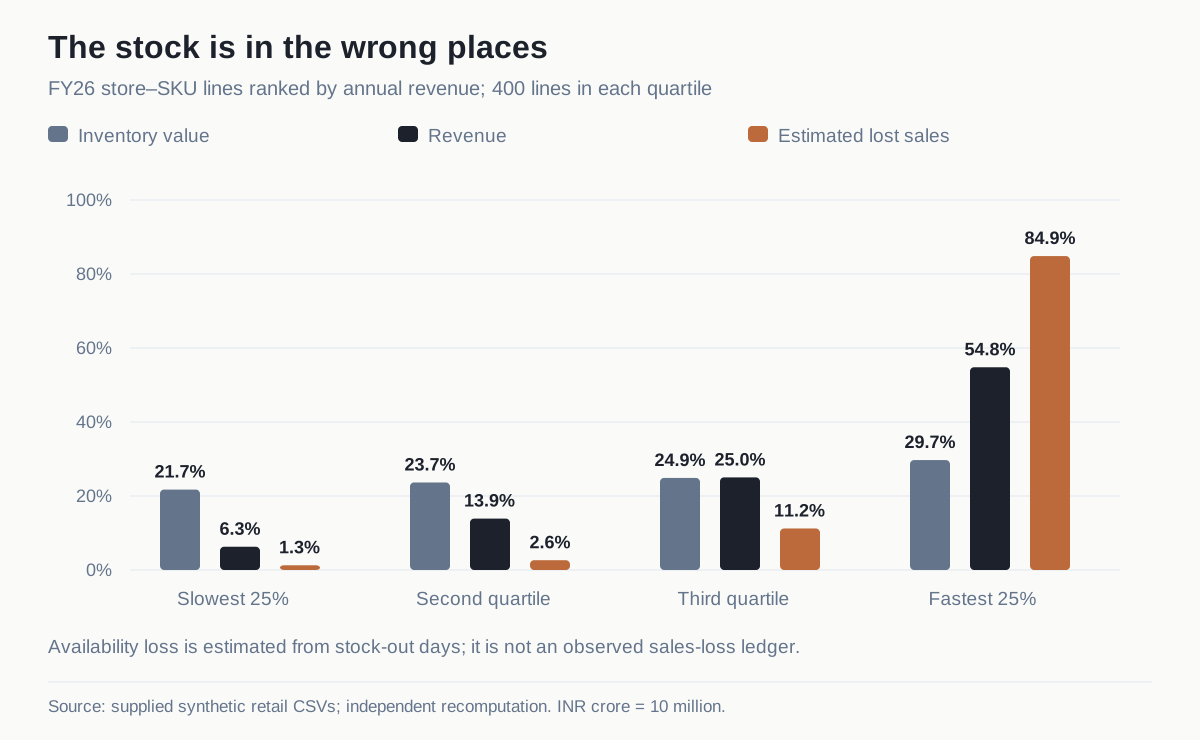
Retail operations / Profitability analytics / Inventory optimisation
Retail Operations Transformation & Profitability Optimisation
An end-to-end retail profitability diagnosis connecting store economics, assortment, inventory and a staged investment case across a simulated 20-store chain.
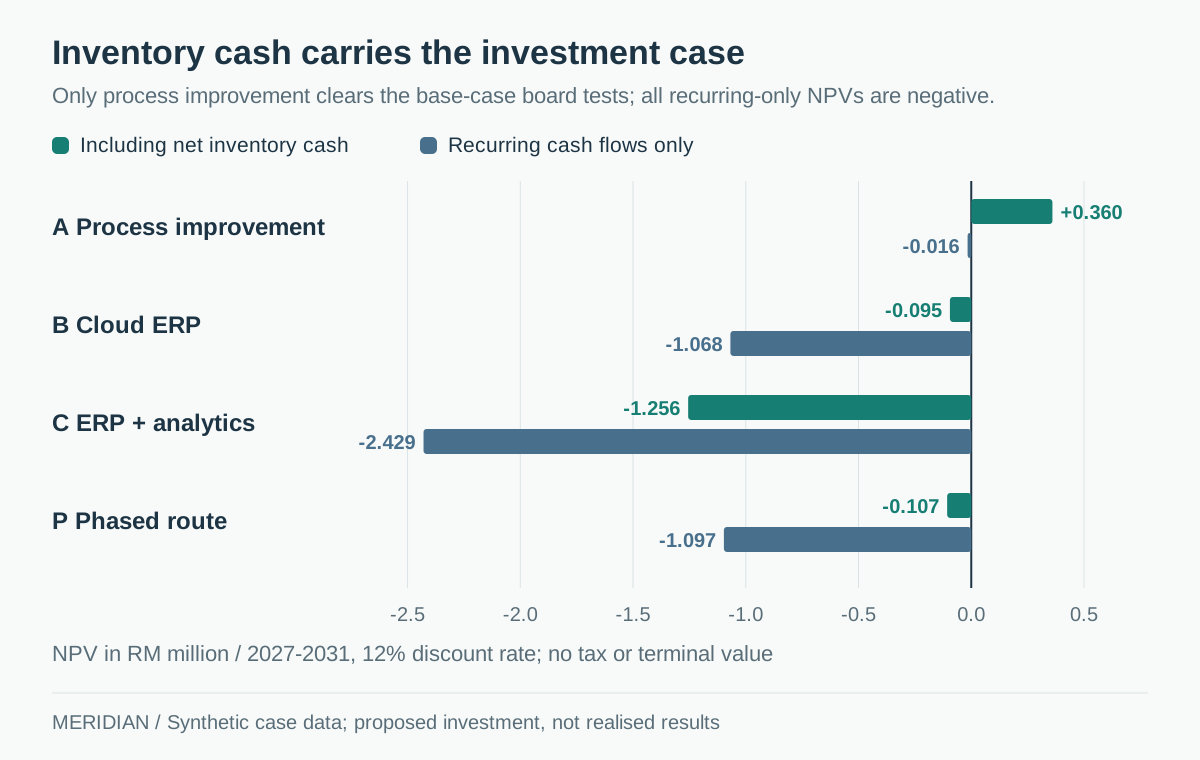
ERP investment / Operations transformation / Financial modelling
Meridian Precision Components: Make the ERP earn its place
A process-first manufacturing transformation strategy that tests an ERP investment against operational evidence, working-capital economics and production risk.
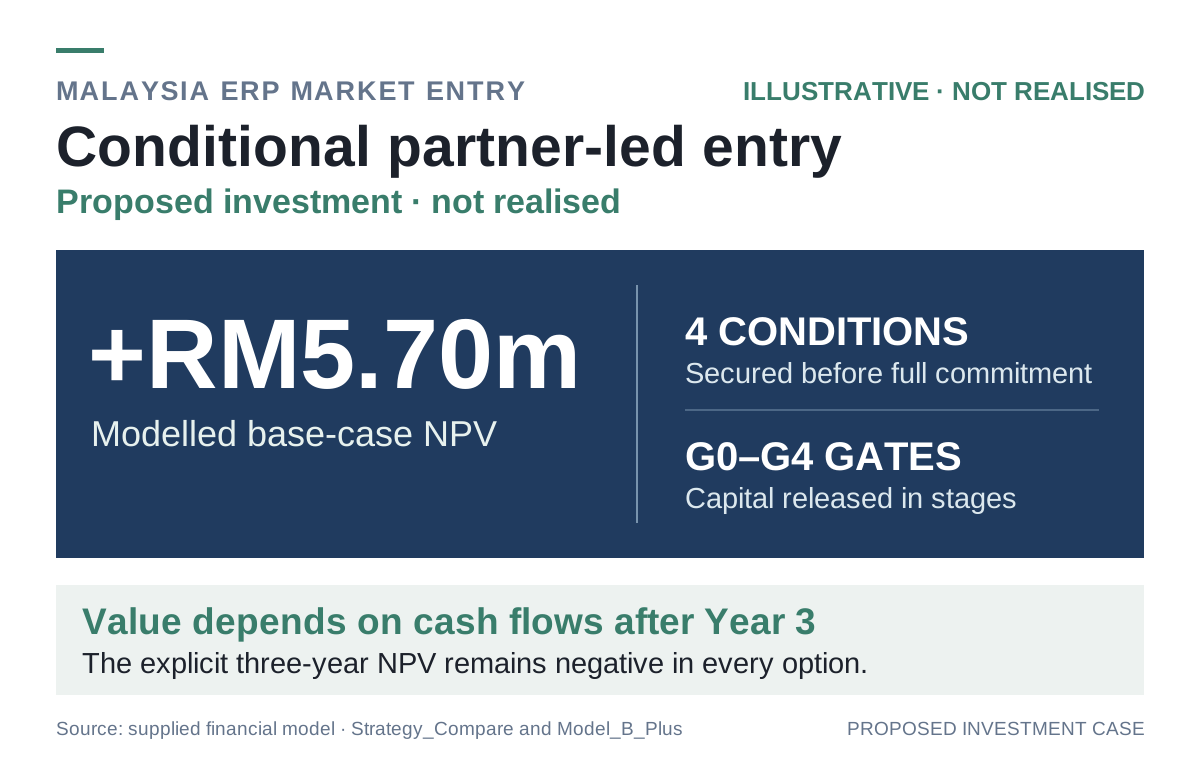
Market entry / Enterprise software / Investment modelling
Malaysia ERP market entry: a stage-gated partnership
A market-entry assessment for an illustrative Indian software company, connecting market sizing and customer focus to a conditional, capital-gated investment case.