Market entry / Investment strategy / Risk management
Build CtrlS’s Malaysia entry around contracted demand
A market-entry strategy that connects customer selection, infrastructure readiness and staged capital commitments for a proposed Cyberjaya facility.
The recommendation
Earn the right to build before committing the full capital envelope.
CtrlS should pursue a phased Malaysian entry focused on regulated enterprises and managed infrastructure. The preferred structure is a Malaysian subsidiary wholly owned by CtrlS, supported by local utility, connectivity and delivery partners. Cyberjaya is the initial location hypothesis. Construction should depend on credible customer commitments, deliverable electricity capacity and a viable downside financial case; national market growth alone cannot establish an investable project.
Decision at stake
Whether to fund a controlled Malaysia entry, which customer segment to serve first, and what evidence must precede each irreversible investment.
An independent Entrepreneurship in Asia study of proposed expansion into Malaysia, using secondary research and public company and market evidence. The entry strategy and implementation plan remain proposals.
Evidence and decision parameters
- 2024 market estimate
- $4.04B
- Historical estimate cited in the assignment and MIDA’s May 2025 release; an indicator of market scale, not CtrlS revenue opportunity.
- Entry modes evaluated
- 4
- Contractual partnership, joint venture, acquisition and wholly owned greenfield investment.
- Proposed expansion threshold
- 60–70%
- Assignment proposal for first-phase reserved or occupied capacity, strengthened here with contract-quality and utility gates.
The investment question beneath the growth story
A data centre commits capital long before utilisation and recurring revenue stabilise. Attractive market forecasts therefore leave the central decision unresolved: can CtrlS secure a differentiated customer base at prices that cover infrastructure, service delivery and financing? The case reframes entry around the sequencing of commercial proof and capital exposure.
The assignment cited MIDA’s 2025 estimate of a Malaysian market growing from US$4.04 billion in 2024 to US$13.57 billion by 2030. That forecast supports investigation, while competing investment can also intensify pressure on power, skilled labour and customer acquisition. The addressable opportunity must be built from qualified accounts and required workloads.
Choose a customer problem that supports differentiation
CtrlS’s colocation, connectivity and managed-services portfolio suggests a more specific proposition than selling generic capacity. The recommended initial customers are banks, insurers, fintech businesses and larger enterprises seeking resilient hosting, disaster recovery and operational support. Indian companies expanding into ASEAN provide an additional relationship-led prospecting pool; their willingness to buy still requires validation.
Cyberjaya should be tested against these customers’ connectivity, latency, procurement and migration needs. The original report identifies an established technology ecosystem, but an ecosystem does not substitute for site diligence. Compare sites on secured power, physically diverse fibre routes, flood exposure, cooling feasibility and expansion options before accepting land-price or location advantages.
Ownership should follow the operating requirements
A contractual partnership reduces early commitment and can support demand discovery, but limits infrastructure control. A joint venture can share funding and local expertise, while introducing governance and service-accountability questions. Acquisition offers speed and an installed customer base, but requires scrutiny of legacy power, cooling and security systems. Greenfield ownership offers design control with the greatest development exposure.
The recommendation is conditional support for a wholly owned subsidiary and modular greenfield development. The report identifies no acquisition target or aligned joint-venture partner, so neither alternative can be conclusively dismissed on economics. Retain a partnership or leased-capacity option if direct ownership fails the commercial or utility gates. Local incorporation and ownership feasibility require project-specific legal diligence.
Turn infrastructure risk into explicit investment gates
Power availability is a critical-path condition. TNB’s 2023 Green Lane announcement described an accelerated connection pathway, but this is a programme statement rather than a binding delivery promise for the proposed site. The investment committee should require a site-specific supply agreement, schedule and allocation of connection costs before authorising the main build.
Customer evidence needs similar discipline. Separate enquiries, indicative reservations and enforceable contracts. Assess counterparty credit, cancellation rights, ramp schedules and power requirements before counting demand toward a construction gate. The report’s proposed 60–70% expansion threshold becomes useful only when reserved capacity has credible revenue backing and the next module has confirmed power.
Make resilience and resource efficiency commercial requirements
The proposed offer combines secure colocation with migration support, managed operations and business continuity. Price each service against its delivery cost and contractual obligations. Premium positioning is a hypothesis to test in customer procurement discussions; it should not conceal uncosted support, discounting or overly demanding service guarantees.
Design modular capacity with high-density zones and a documented cooling upgrade path. Evaluate energy and water performance across expected utilisation levels, rather than presenting a design efficiency figure as an operating result. MIDA’s sustainable-development guideline supports explicit energy, carbon and water measurement. Local engineering, compliance and customer-support capability should be included in operating costs from the outset.
Measure value through cash conversion and disciplined expansion
The next analytical deliverable should be a site-level financial model linking contracted capacity, ramp-up, electricity costs, construction timing and service staffing to cash flow. Test delayed commissioning, slower occupancy, cost escalation and currency exposure together. A negative downside case should trigger a smaller first module, revised terms or deferral.
Track contracted versus available capacity, revenue per deployed unit, service contribution, cash collection, commissioning variance and reliability. Pair these with actual energy and water intensity and local skills development. This connects the commercial thesis to operational evidence and gives the investment committee a defensible basis to continue, resize or stop.
Strategic priorities
Approve development diligence before full construction
Give the country lead a bounded mandate to validate customers and sites. Release the main capital envelope only after commercial, utility, engineering and financial approvals converge.
Sell the managed enterprise proposition first
Test service bundles and migration requirements with priority accounts. Use the resulting workload and contract evidence to size the first module and price operational support.
Keep the next module conditional
Combine the proposed occupancy threshold with enforceable demand, confirmed incremental power, service performance and an updated investment case. Avoid automatic expansion on elapsed time.
Path to implementation
Proposed sequencing and decision gates.
Months 1–6 · Proposed
Validate the entry thesis
Country lead and strategy team qualify anchor accounts, compare sites and commission local legal and utility diligence.
Decision gate: A credible customer pipeline, feasible ownership structure and deliverable utility options support further development spending.
Months 4–9 · Proposed
Make the first module investable
CFO, development director and engineering lead reconcile contracts, capex, cooling, connectivity and downside cash flows.
Decision gate: Investment committee accepts contract quality, utility commitments, contingency and downside exposure before the main build.
Months 7–25 · Proposed
Build and prove operational readiness
Delivery and operations leaders manage procurement, local recruitment, training and integrated commissioning tests.
Decision gate: Independent technical acceptance and customer migration readiness precede production workloads.
Months 26–30 onward · Proposed
Launch and earn expansion approval
Country management reviews contracted utilisation, cash performance, reliability and resource intensity with the investment committee.
Decision gate: Expansion requires credible capacity demand, additional power and an approved updated business case.
Value and measurement
The deliverable is a decision framework for customer focus, ownership and phased capital allocation. Its prospective value is reducing unsupported investment and aligning facility scope with contracted needs. No Malaysian facility, customer contract, investment return or implementation result is claimed.
Sources and scope
The source report is secondary research. It contains no customer interviews, site quotations, binding utility offers or complete project financial model. Market estimates are historical context; proposed timelines and gates are planning assumptions. Site, legal, competitor and incentive conditions need refreshed diligence before an actual investment.
Original academic analysis
APU Assignments.zip → Entraprenureship in Asia_Assignment → CtrlS_Malaysia_Market_Entry_Report_Formatted.docx. Individual report; assessment brief treated as context, not project evidence.
- MIDA · Data Centre Nexus, May 2025 (opens in a new tab)
Verified historical market estimates and local ecosystem priorities cited in the report.
- TNB · Green Lane Pathway, August 2023 (opens in a new tab)
Utility programme announcement; does not establish delivery timing for a specific CtrlS site.
- MIDA · Sustainable data-centre guideline (opens in a new tab)
Primary framework informing proposed energy, carbon and water diligence.
- CtrlS · Company and service portfolio (opens in a new tab)
Primary company source supporting the colocation and managed-services capability fit.
Continue reading
Related case studies
Market entry / Financial modelling / Commercial strategy
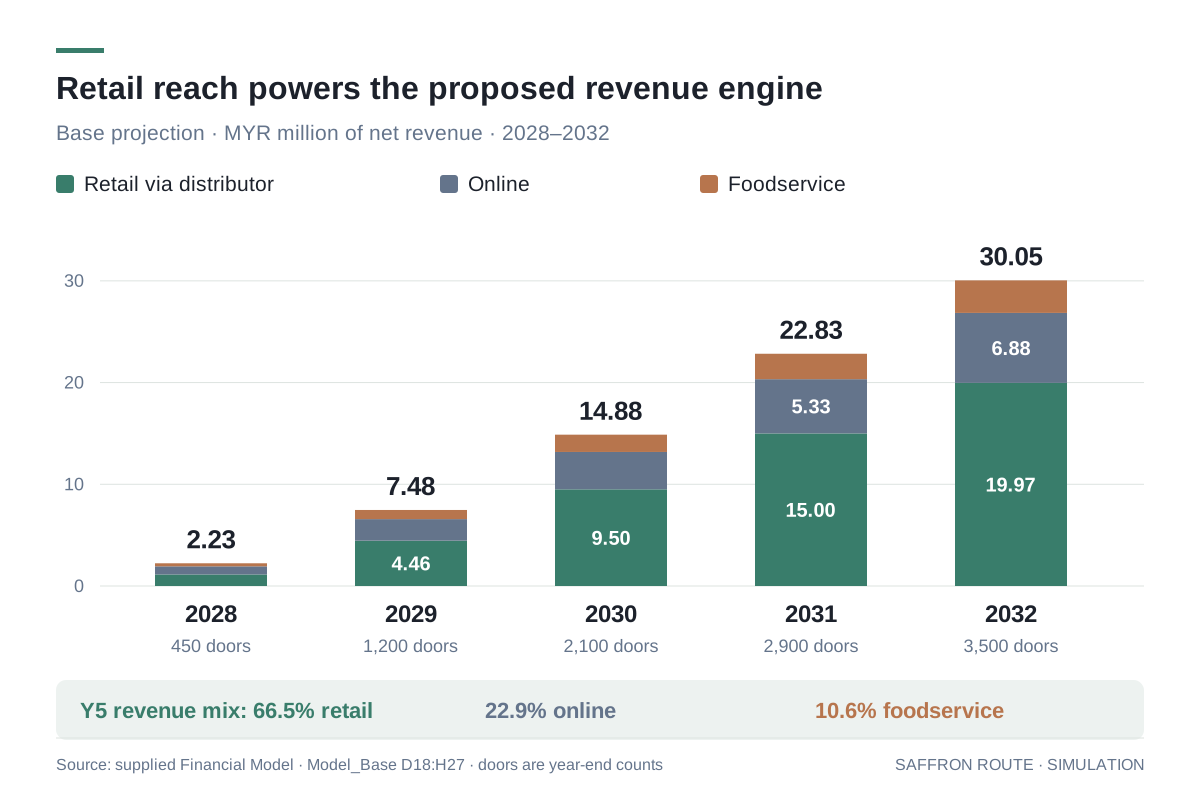
Saffron Route Foods: a staged route into Malaysia
An evidence-led market-entry case connecting consumer segmentation, distributor economics and a five-year financial model to explicit investment gates.
Market entry / Enterprise software / Investment modelling
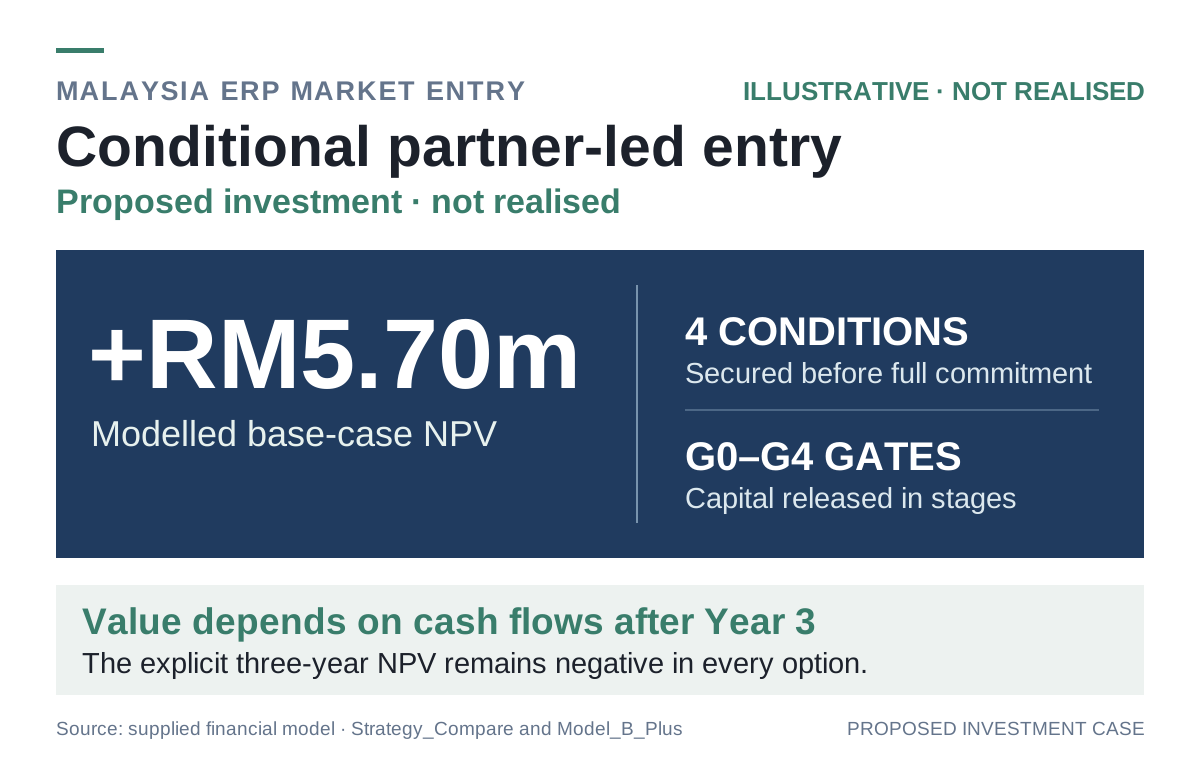
Malaysia ERP market entry: a stage-gated partnership
A market-entry assessment for an illustrative Indian software company, connecting market sizing and customer focus to a conditional, capital-gated investment case.
Retail operations / Profitability analytics / Inventory optimisation
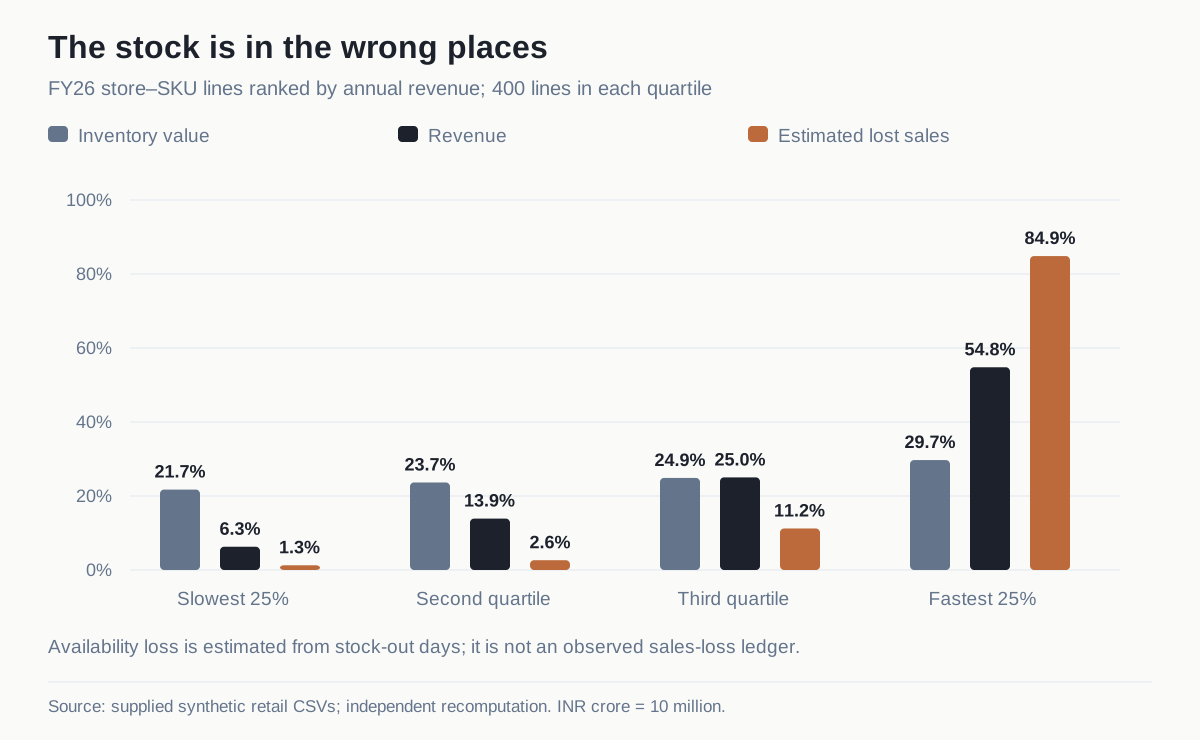
Retail Operations Transformation & Profitability Optimisation
An end-to-end retail profitability diagnosis connecting store economics, assortment, inventory and a staged investment case across a simulated 20-store chain.