Localisation strategy / Customer onboarding / Responsible AI
Airwallex: Scale local relevance with accountable AI
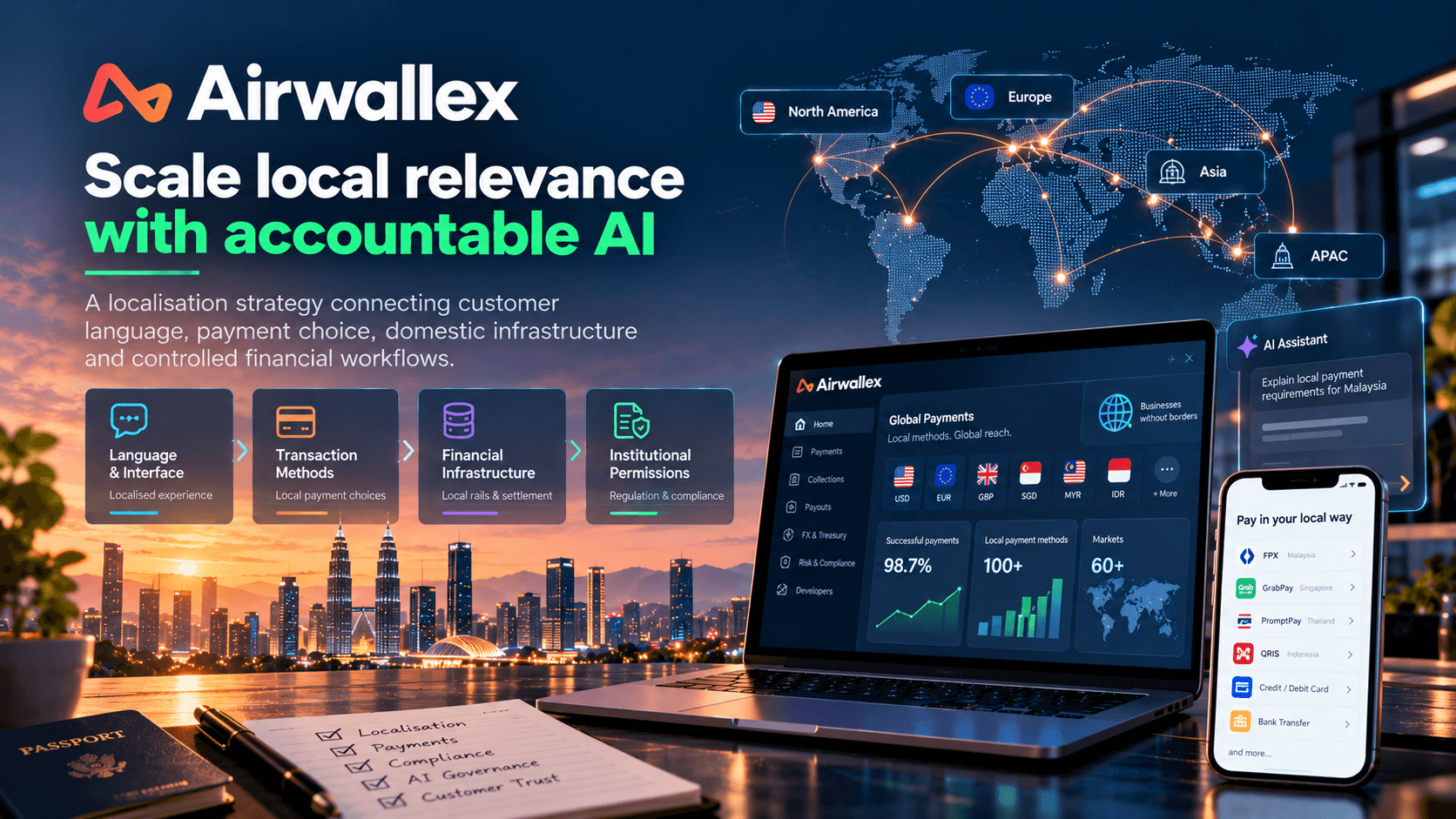
A four-layer localisation strategy connecting customer language, payment choice, domestic infrastructure and controlled financial workflows.
The recommendation
Localisation succeeds when the customer experience, payment infrastructure and decision controls work as one system.
Manage localisation across four connected layers: language and interface, transaction methods, financial infrastructure and institutional permissions. Use generative AI initially to interpret business context and explain approved information, with controlled access and accountable review. Localisation should improve task completion and customer trust while maintaining risk performance. Market coverage, translated screens and faster onboarding are useful inputs, but none alone demonstrates sustainable customer value.
Decision at stake
Prioritise a small set of market journeys and controlled AI use cases; expand only after local task performance, risk outcomes and support economics are understood.
An independent analysis of how a global business-finance platform adapts across markets, focused on making localisation useful, economically viable and trustworthy.
Evidence and decision parameters
- Localisation layers
- 4
- An analytical framework from the assignment, not an official Airwallex operating model.
- Company-reported false-positive reduction
- 50%
- Airwallex's December 2023 internal comparison for a component of KYC; not an independently verified study result.
- Proposed next step
- Controlled pilot
- No customer testing, implementation or financial result was delivered by this case study.
Global consistency can hide local friction
A single platform interface is efficient to maintain, but a business customer still operates within local currencies, payment practices and eligibility rules. Translation cannot fix a missing payment method, unexpected settlement treatment or an unavailable service. The strategic task is to preserve a coherent core while adapting the elements that materially affect a customer's ability to complete a financial task.
A four-layer framework makes these dependencies visible. Language improves comprehension; transactional localisation supports familiar payment choices; infrastructural localisation connects domestic financial systems; institutional localisation determines what may be offered. The layers interact, while serving distinct functions. Cultural and behavioural preferences matter alongside the economic and institutional conditions that govern a financial service.
Evaluate the journey behind the coverage claims
Airwallex's Hosted Payment Page documentation describes supported languages, browser-locale behaviour and filters for available payment methods. Its FPX documentation provides a concrete Malaysian example with eligibility, currency and settlement conditions. This primary evidence shows adaptation at the transaction level. It also demonstrates why a generic claim of local availability needs qualification by entity, account and payment configuration.
The proposed diagnostic would follow a merchant and shopper journey from eligibility checks through checkout, settlement, reconciliation and exception handling. Where does a customer encounter an unexpected currency, unfamiliar wording or unexplained restriction? National averages can inform research priorities; they should not determine an individual customer's preferred language, payment method or tolerance for automation.
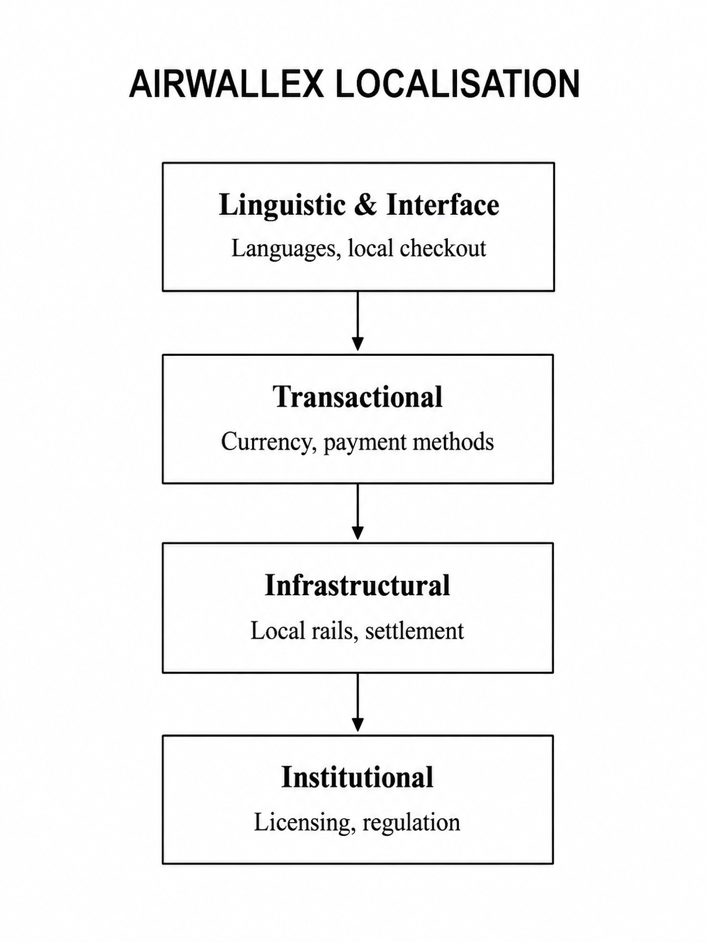
Figure 1. Localisation has four connected layers
The author's framework separates what customers see from how transactions are supported and permitted locally. It helps evaluate a complete market journey rather than treating translated screens or currency coverage as sufficient evidence of localisation.
Interpretation: This is the author's analytical framework, not Airwallex's official operating model. The arrows organise connected layers; they do not establish causal effects or a mandated implementation sequence.
Source: TCP_Individual Assignment.docx · Figure 1 · Author's conceptualisation based on the Airwallex and localisation literature cited in the original report.
Distinguish contextual interpretation from autonomous decisions
Airwallex's December 2023 announcement describes an LLM-based website scanner that distinguishes risky keywords from their business context. It reports fewer false-positive alerts and a 20% increase in customers moving through fully automated KYC, relative to its earlier process. The evidence points to reduced unnecessary review in a defined workflow; the absolute share of customers automated is not established by that figure.
Those results are company-reported and concern a component of due diligence. They do not prove lower financial crime risk or accurate performance in every language. The recommended role for AI is bounded: assemble relevant context, produce a reasoned explanation and route uncertainty to authorised reviewers. Customer-facing guidance should use approved product and jurisdiction information, with actions governed by existing permissions.
Choose modular adaptation with explicit decision ownership
A global minimum product keeps costs low but can create avoidable local failures. Separate products for every market improve tailoring but multiply maintenance and control requirements. A modular model offers a middle course: shared identity and workflow foundations with configurable language, payment methods, eligibility and support content, owned jointly by platform and market teams.
The AI investment should follow the same discipline. Unrestricted conversational execution creates a wide operational surface before value is established. A read-only explanation pilot is easier to inspect and reverse. More consequential tasks would require separate validation, confirmation and authorisation. The IMF's financial-sector risk note reinforces the need to evaluate hallucination, bias, privacy, robustness and cybersecurity alongside convenience.
Measure trust, risk and task completion together
Define a baseline for eligible onboarding completion, time to a decision, repeat document requests and support contacts. Assess false positives against reviewer-adjudicated examples and evaluate false negatives with an appropriately governed test set. Review results by language, market and business type; a lower average review workload can conceal a poorly served subgroup.
For the customer pilot, test task completion and explanation accuracy using realistic, permissioned scenarios. Measure whether customers understand fees, settlement and escalation options. Finance should track support cost and contribution from retained, active customers after localisation costs. Expansion requires a credible gain without weakened risk outcomes or misleading guidance; faster completion alone is insufficient evidence for scale.
Strategic priorities
Build a market readiness matrix
Map customer tasks to supported languages, methods, settlement arrangements, entity eligibility and approved support content. Assign a platform owner and market owner to each gap.
Constrain AI to verified context
Start with explanations and reviewer assistance using approved knowledge and permissioned data. Make uncertainty and escalation visible, and keep consequential actions under existing authorisation controls.
Evaluate local performance
Review accuracy, completion and risk by market and language, alongside support costs. Avoid treating coverage counts or demographic assumptions as evidence of customer success.
Path to implementation
Proposed sequencing and decision gates.
Weeks 1–4 · proposed
Select a bounded customer journey
Product, market operations and risk teams map one onboarding or payment-support journey, validate entitlements and assemble representative evaluation examples.
Decision gate: Proceed when an accountable risk owner approves scope, data access, evaluation criteria and escalation responsibilities.
Weeks 5–10 · proposed
Test explanations and assisted review
A product team pilots read-only support or reviewer assistance. Qualified reviewers assess reasoning, product accuracy and language differences; support teams record customer friction.
Decision gate: Continue only with acceptable accuracy and risk performance across relevant subgroups, with unresolved exceptions handled by people.
After controlled evaluation · proposed
Expand markets and capabilities separately
Finance and platform leadership evaluate recurring costs. Each additional market or consequential action receives a distinct readiness and control review.
Decision gate: Scale when the local business case, accountable service model and monitored risk controls are demonstrated.
Value and measurement
The output is a localisation framework, a proposed modular delivery model and an AI evaluation plan. Its intended impact is more useful local journeys with controlled operating complexity. The case does not represent employment, commissioned consulting or deployment for Airwallex; reported KYC improvements belong to the company's own historical evidence.
Sources and scope
The analysis uses public documentation and the original academic research, without merchant interviews, proprietary risk datasets or unit economics. Product support and eligibility change, so any implementation requires a fresh configuration review. No claim is made that every proposed interaction is an existing Airwallex feature or that the company's internal AI comparison establishes causal customer or risk outcomes.
Original independent report
APU Assignments.zip · Technology Culture & People_Assignment/TCP_Individual Assignment.docx · Airwallex localisation and GenAI chapter.
- Airwallex · KYC generative AI announcement (opens in a new tab)
December 2023 company evidence; the note clarifies both the false-positive measure and the increase in automated processing.
- Airwallex · Hosted Payment Page documentation (opens in a new tab)
Primary documentation of locale behaviour and payment-method configuration.
- Airwallex · FPX documentation (opens in a new tab)
Primary Malaysian payment-method example with eligibility and currency conditions.
- IMF · Generative AI in finance (opens in a new tab)
2023 primary institutional analysis of financial-sector model risks and governance considerations.
Continue reading
Related case studies
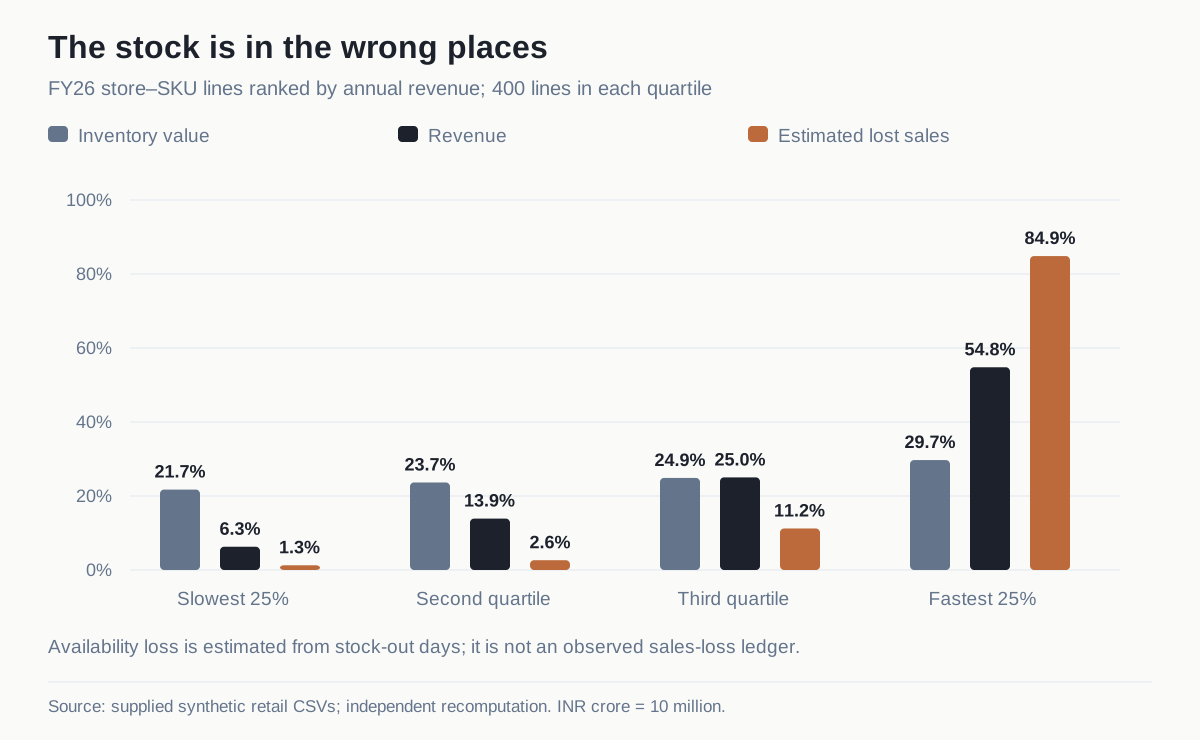
Retail operations / Profitability analytics / Inventory optimisation
Retail Operations Transformation & Profitability Optimisation
An end-to-end retail profitability diagnosis connecting store economics, assortment, inventory and a staged investment case across a simulated 20-store chain.
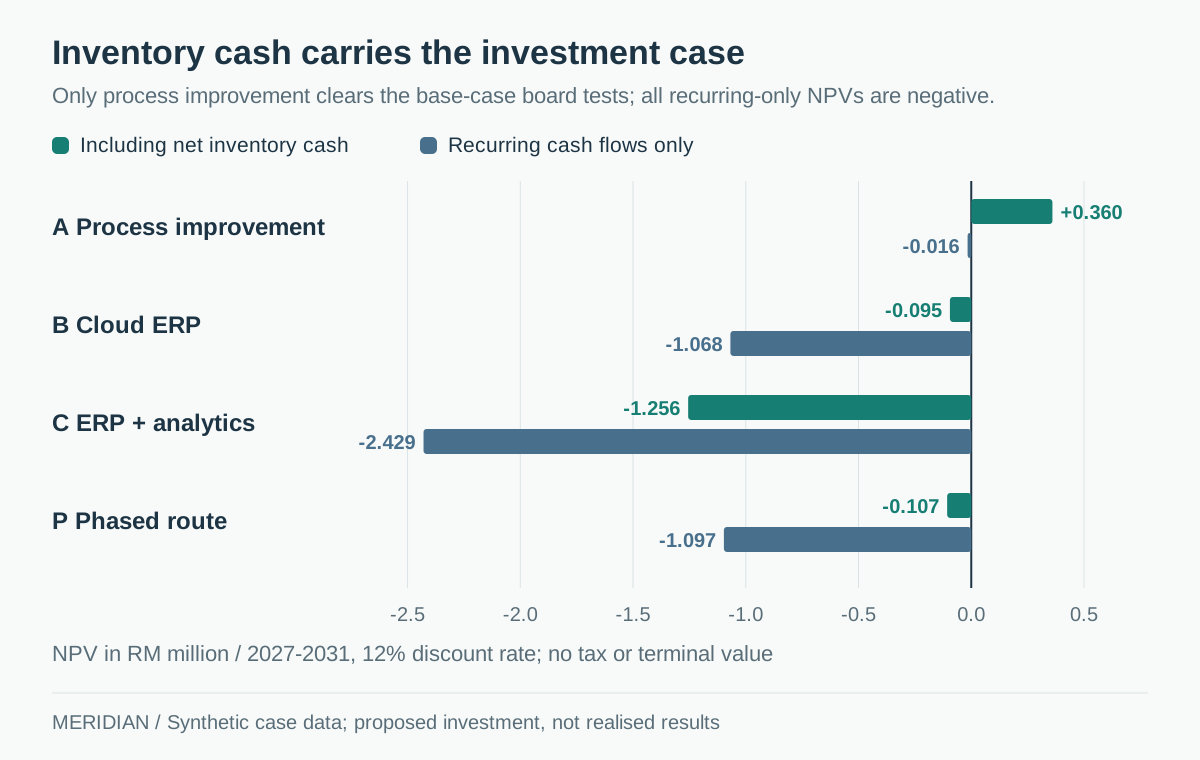
ERP investment / Operations transformation / Financial modelling
Meridian Precision Components: Make the ERP earn its place
A process-first manufacturing transformation strategy that tests an ERP investment against operational evidence, working-capital economics and production risk.
Market entry / Enterprise software / Investment modelling
Malaysia ERP market entry: a stage-gated partnership
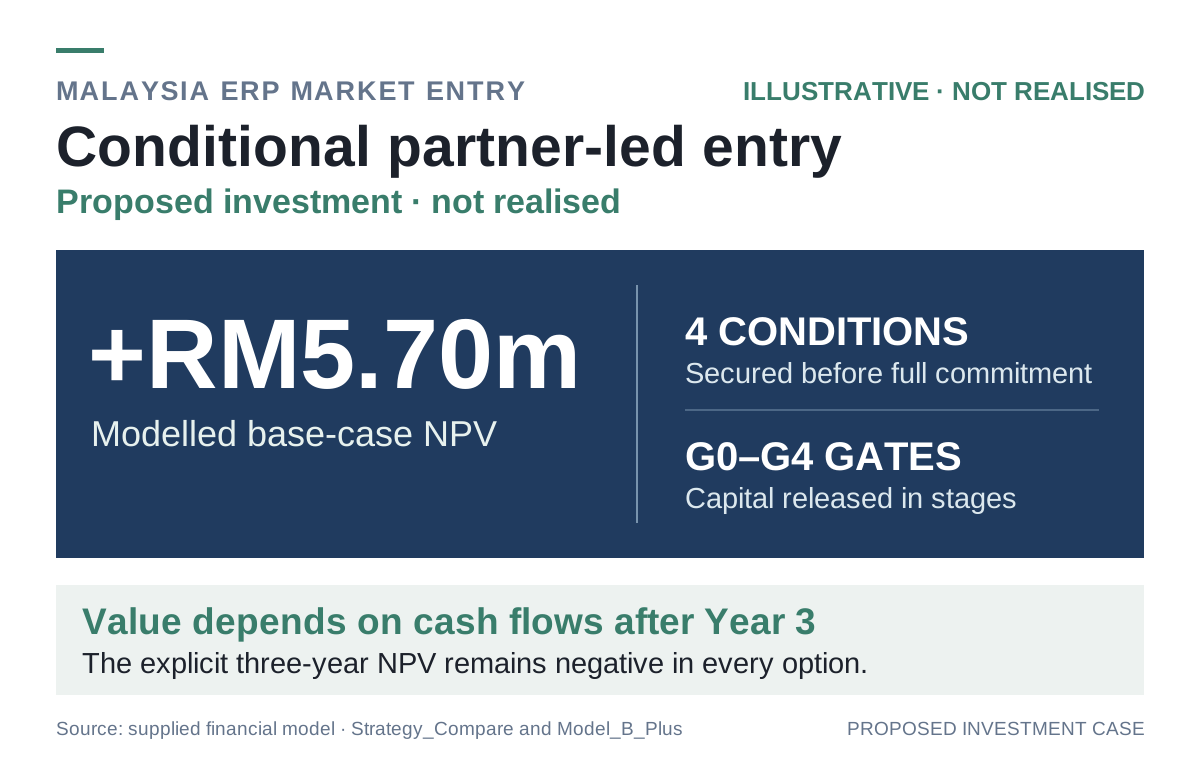
A market-entry assessment for an illustrative Indian software company, connecting market sizing and customer focus to a conditional, capital-gated investment case.